


Breathing exercises for burnout: what the evidence really says
If you have ever been told to "just breathe" when you were close to burnout, you know how that lands. Probably somewhere between unhelpful and slightly insulting. So this piece is not that. It is a careful look at what the recent evidence actually shows about breathing exercises for burnout: what slow paced breath does, what it doesn't, and where it fits in a recovery that includes a lot more than the breath itself.
The short version: slow breathing has real, replicated effects on stress and mood, with a clear physiological mechanism behind it. It also is not, on the current evidence, a treatment for burnout on its own. Knowing the difference is the point of this piece.
Here is what the studies measure, what they found in 2023, and how breath fits into the bigger recovery picture.
What burnout actually is, and what the scales measure
Burnout is not a diagnosis in the DSM. In the WHO's ICD-11, updated in 2019, it is classified as an occupational phenomenon: chronic workplace stress that has not been successfully managed. That distinction matters when you read a study. The trials don't measure "burnout" in a single sense. They measure it through validated scales.
Three scales come up most often. The Maslach Burnout Inventory (MBI)* assesses emotional exhaustion, depersonalisation (a sense of detachment from the work), and reduced personal accomplishment. The Copenhagen Burnout Inventory (CBI)* splits exhaustion into personal, work-related, and client-related. And the Perceived Stress Scale (PSS-10)* — Cohen's general stress questionnaire — is often used as a stress-load proxy that contributes to burnout, not as a burnout score itself.
*MBI: 22-item self-report. CBI: 19-item self-report. PSS-10: 10-item self-report, scores how unpredictable and overwhelming the last month felt.
The practical reader's question to ask of any study: which scale moved? If a trial reports a reduction in PSS-10, that is a real signal about perceived stress. It is not the same as a reduction in MBI emotional exhaustion. Both are useful. They are not interchangeable.
In a Dutch context, the RIVM Volksgezondheid Toekomst Verkenning estimates that roughly one in six working-age adults reports work-related psychological complaints. That is the population the question lives in.
What "slow breathing" actually means in the trials
When researchers test "breathwork," they don't mean a deep breath at your desk. They study specific, paced, dosed protocols. The most common are around 5 to 6 breaths per minute, with a longer exhale than inhale, sustained for 5 to 20 minutes per session. A 2014 review in Frontiers in Psychology (Lehrer & Gevirtz) describes this pattern as the engine behind heart rate variability biofeedback, and the mechanism is the baroreflex*: slow exhalation activates pressure receptors in the carotid arteries, the heart rate slows, and the parasympathetic (rest-and-recovery) side of the nervous system gets more weight.
*The baroreflex is a feedback loop that helps keep blood pressure stable from one heartbeat to the next. It also responds to the rhythm of your breath.
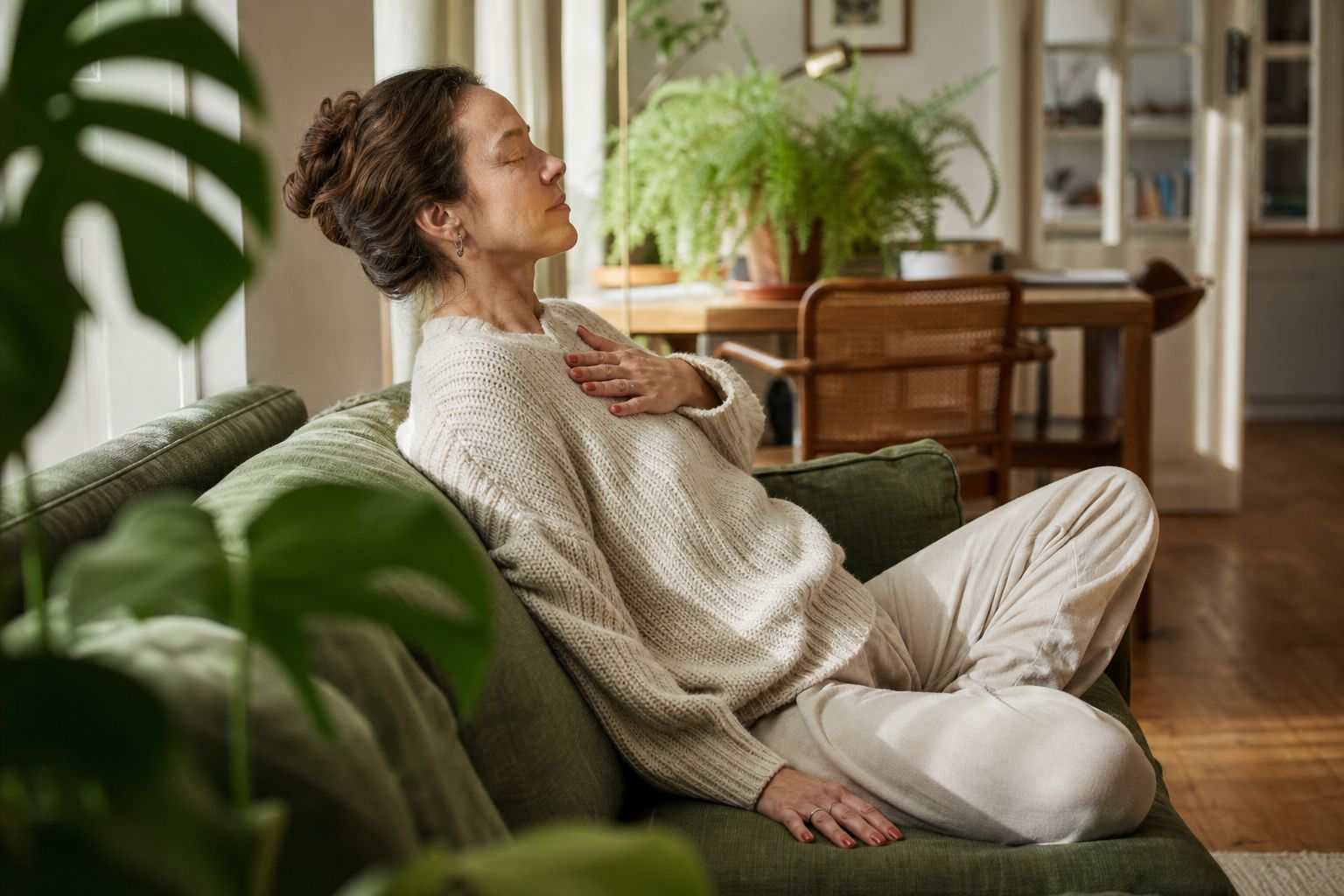
Two specific protocols appear most in the recent literature:
- Resonant or coherent breathing at around 5.5 breaths per minute. Steffen et al. (2017) in Frontiers in Psychology showed that even 5 minutes a day produced measurable improvements in HRV and well-being in healthy adults.
- Cyclic sighing, studied by Balban et al. (2023) in Cell Reports Medicine: two inhales through the nose followed by one long exhale through the mouth, repeated for 5 minutes. In their trial, a daily 5-minute cyclic sighing practice produced greater improvements in mood and lower respiratory rate than equivalent-time mindfulness meditation.
When a study reports an effect, it is talking about a protocol like one of these. "Breathing for chronic stress" in the wellness sense usually isn't.
What the 2023 evidence review for breathing exercises for burnout actually found
The most useful piece of recent evidence is a 2023 meta-analysis in Scientific Reports by Fincham and colleagues. They pooled 12 randomised controlled trials of breathwork interventions in non-clinical adult populations (785 participants in total) and compared them with either active controls (another well-being intervention) or passive controls (no intervention).
Plainly: the analysis found small-to-moderate reductions in self-reported stress, and small reductions in symptoms of depression and anxiety. The headline effect size for stress sat around g = -0.35. That is a real, measurable effect. It is not a transformative one. It sits in the same range as a sensible mindfulness programme.
The authors are careful about what the analysis does and doesn't say. The trials used different protocols, often with small samples and short follow-up windows (mostly under 8 weeks). Risk-of-bias concerns showed up in several of the included studies. What the meta-analysis does not answer is whether the effect holds in people with diagnosed clinical burnout, how durable the benefit is once the protocol stops, or which specific breathwork pattern works best for whom.
If you are looking for honest evidence that slow breathing helps with stress and mood, the answer is yes, at the population level, for the kinds of trials run so far. If you are looking for evidence that breathwork on its own treats burnout, the answer is: not yet. The studies haven't been done.
Burnout recovery techniques: where slow breathing actually fits
Burnout recovery, when it goes well, looks like a stack of things working together: rest, professional support, sleep stabilisation, work-load change, and a gradual return to activity. The Dutch GP guideline (NHG-standaard overspanning/burn-out) places professional support and graded recovery at the centre, with a person's GP and bedrijfsarts (occupational physician) coordinating the plan. International guidance broadly agrees.
Slow paced breathing is reasonably placed inside that stack as an adjunct, not the centrepiece. What the evidence supports is that it can:
- Lower acute stress reactivity in the moment, measurable in HRV and reported stress.
- Support sleep onset on nights when the mind won't settle.
- Give the person a portable down-regulation tool they can use through the day, without needing equipment or a 30-minute window.
What the evidence does not support is using slow breathing to:
- Undo the workload conditions that produced the burnout.
- Reverse cognitive symptoms on its own (concentration loss, brain fog).
- Replace medication, therapy, or graded return-to-work when those are indicated.
If a programme sells breath alone as a burnout fix, the programme has run ahead of the evidence. If a programme positions breath as the part of recovery that you can do for yourself, with a defensible mechanism behind it, that sits closer to what the literature says.

A minimum-viable 5-minute daily protocol
If you want one practical protocol the evidence supports for breathing for chronic stress, the simplest is the Steffen one: 5 minutes a day at around 5.5 breaths per minute, longer exhale than inhale. That looks like: inhale for 4 seconds, exhale for 6 to 7 seconds, repeat for 5 minutes. It is intentionally undemanding. The studies show effects on consistency, not intensity.
Two notes for the burnout context specifically. First, counting your own breath while exhausted is harder than it sounds. Cognitive load is part of what burnout is doing to you, and a counting task adds load when you can least afford it. Some people find a phone-based timer works fine; others find that anything requiring screen attention defeats the purpose. A tactile pacer (a device that vibrates in your hand on the inhale and exhale) takes the counting off your plate altogether. That is the small fit for a tool like Pebbles paces a slow breath in your hands in burnout recovery: it removes the part you don't have spare capacity for.
Second, the protocol is not a performance. Five quiet minutes most days is more useful than 20 minutes once a week. If you miss two days, you haven't broken anything. Pick a window in your day that already exists (after lunch, before bed, the moment the kids are asleep) and let it land there.
What the evidence still doesn't say
A short list of open questions worth holding, the next time you read a confident claim about breathwork and burnout:
- Dose-response. Is more breathing better, or does benefit plateau? The literature has not settled this.
- Durability. How long does the benefit hold once the daily practice stops? Most follow-up windows in published trials are short.
- Population. Does the effect generalise from healthy adults in trials to people currently signed off work with burnout? Most of the meta-analysis evidence is from non-clinical populations.
- Mechanism versus expectancy. How much of the effect is the physiological mechanism (vagal activation, baroreflex training), and how much is the same expectancy effect that other well-being interventions produce?
- Individual response. Why does the same protocol shift some people's mood and leave others' unchanged?
None of these open questions means the evidence is weak. It means the evidence is honest. The 2023 review supports a measured statement: slow paced breathing is a reasonable, low-risk practice with a real mechanism and replicated small-to-moderate effects on stress and mood. It is not a treatment in any regulatory sense. Treat it as what it is.
Two questions worth sitting with, the next time you think about adding a breathing practice to your week. What does an honest version of slow breathing look like for you, given what your week actually contains? And what other parts of your recovery (rest, support, workload) does breath sit alongside, rather than replace?
For many people in burnout recovery, Glimp's evidence base for paced breathing sits inside a wider plan that already includes a GP, a workplace conversation, and time. You can keep counting your breath in your head, judging each one. Or you can let the counting happen somewhere else and notice what your attention does when it is freed. Pebbles paces a slow breath in your hands if a tactile pacer helps; the Glimp app holds a guided session at this pattern if it doesn't.
If the workplace side of this is what is on your mind, the Glimp x Univé workplace pilot sits next to this post, and the piece on why one extended exhale keeps showing up in mood trials covers the cyclic sigh in more depth.


